
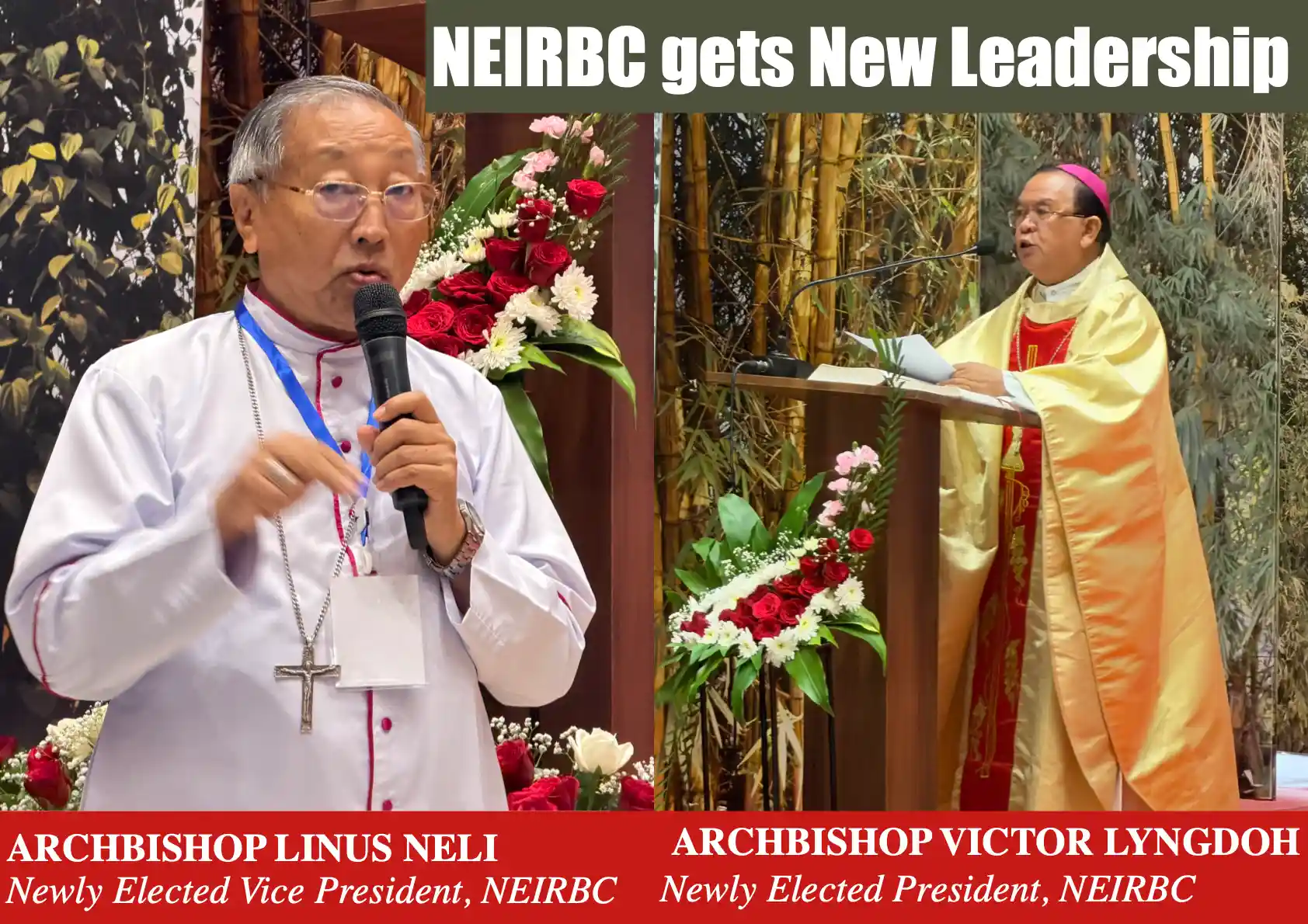
Shillong, September 9, 2026: Archbishop Victor Lyngdoh of Shillong has been elected President of the North East India Regional Bishops’ Council (NEIRBC), while Archbishop Linus Neli of Imphal has been elected Vice President, as the regional bishops’ council constituted its new leadership during its meeting in Shillong.
Archbishop Lyngdoh succeeds Archbishop John Moolachira of Guwahati, who is set to retire later this year. Archbishop Linus Neli, Archbishop of Imphal, had been serving as the Chairman of Youth Commission of the regional council and now takes up the responsibility of Vice-President.
Bishop James Thoppil of Kohima has been re-elected Secretary General for another term. Fr. GP Amal of the Diocese of Dibrugarh will continue to serve as Deputy Secretary, an appointed position within the council. He has been serving in this responsibility for the past 12 years, having received the office from Fr. Thomas Manjaly. His long service provides valuable continuity and institutional experience to the work of the regional bishops’ council.
According to Article 22(a) of the revised NEIRBC Statutes of 2026, the term of office of the office-bearers is three years, renewable for another term. The provision marks a change from the 2014 Statutes, which provided for a four-year term, renewable for another four years. The revised statutes bring the term of office into a three-year cycle, with the possibility of one more term.
The elections were held in Shillong following the conclusion of the North East India Regional Pastoral Conference in Guwahati on September 7. The bishops travelled to Shillong after the four-day pastoral gathering for the meeting of the regional council, which concluded this evening with the election of the new office-bearers.
The NEIRBC is one of the 14 regional bishops’ councils in India and provides a platform for the bishops of the Northeast to reflect together, coordinate pastoral initiatives and strengthen collaboration among the dioceses and ecclesial institutions of the region.
Archbishop Victor Lyngdoh: From Shillong priest to regional leadership
Archbishop Victor Lyngdoh had been serving as Vice President of the NEIRBC before being elected President. His pastoral journey has taken him through several significant stages of ecclesial leadership in the Northeast.
A priest of the Archdiocese of Shillong, he became the first Bishop of Nongstoin in 2006 following the establishment of the diocese. After serving there for a decade, he was appointed Bishop of Jowai in 2016. In 2020, he was appointed Metropolitan Archbishop of Shillong.
His journey—from priest of Shillong to the first Bishop of Nongstoin, then Bishop of Jowai and finally Metropolitan Archbishop of Shillong—has given him a distinctive pastoral experience of different ecclesial contexts within the region.
As Archbishop of Shillong, he leads the Catholic Church in Meghalaya, a state with a significant Catholic presence and a long history of Christian missionary and pastoral engagement.
Archbishop Linus Neli: pastoral, academic and canonical experience
The newly elected Vice President, Archbishop Linus Neli of Imphal, brings to the regional leadership a combination of pastoral, academic and canonical experience.
A canonist and academician, Archbishop Neli has served the Church in various pastoral and ecclesial responsibilities. He also serves as Chairman of Caritas India, bringing experience in social action, humanitarian service and the Church’s mission of reaching communities in need.
His leadership of the Archdiocese of Imphal and his wider responsibilities in the Church place him in a position to contribute to the regional council’s efforts towards greater pastoral coordination and collaboration across the Northeast.
The new leadership assumes office at an important moment for the Church in Northeast India, following the Regional Pastoral Conference held under the theme “Journeying with Indigenous People of God in the Synodal Church in NEI.”
The revised statutes, the new office-bearers and the conclusions of the pastoral conference together mark an important phase in the continuing journey of the Church in the Northeast towards greater synodality, collaboration and contextual pastoral renewal.